The narrated visual edition and MP3 audio edition of rapid learning biology courses are now available at our new learning portal Rapid Learning Center.
Note: If you are a legacy user of chemistry24 members, please request a new login access to the premium server with your full name and old login email via vip@rapidlearningcenter.com
Want
to learn all the tips and tricks
on biology mastery? Learn from the
insiders and gain unfair advantage
over your peers. This free newsletter
is specifically designed for students
who are taking biology. Start having
the tips delivered to your inbox
daily, enter your name and email
below to subscribe:
Community Interactions
Interspecific competition for limited resources determines species diversity in some communities. Closely related species can coexist if there are one or more significant differences in their niches. Predation has important roles in the evolution of defensive adaptations in the prey species. Symbiosis has different impacts on a community. Parasitism resembles the predator-prey relationship but does not kill the host. It shows coevolution. Dynamic multiple interactions of organisms with both biotic and abiotic aspects of their environment results in a complex community property, the composition of species. Succession occurs when the community composition changes.
Ecosystem Components
Ecosystem is the level of ecological study that includes all the organisms in a given area along with the abiotic factors with which they interact. Most ecosystems are driven by energy from sunlight. Energy flow and chemical cycling are two inter related processes that occur by transfer of substances through the feeding levels of ecosystems. Trophic levels begin with producers, autotrophic organisms that support all other components of the community. The main producers in photosystems are photosynthetic autotrophs. Primary productivity is the rate at which light energy is converted to the chemical energy of organic compounds by autotrophs in an ecosystem. Biogeochemical cycles are the various nutrient circuits which involve both biotic and abiotic components of ecosystems. Three important chemical cycles are carbon, nitrogen and phosphorus cycles. The biosphere is a kind of superorganism with a self regulated metabolism that helps counter fluctuation in the physical environment. Processes occurring at one location can have far reaching effects and consequences.
Aquatic Ecosystems
Aquatic ecosystems include rivers ands streams, estuaries, lakes and ponds. Aquatic ecosystems make up most of the life on Earth, yet are poorly understood. Aquatic ecosystems are often classified by how much light they receive or how deep they are.
Terrestrial Biomes
Biomes are a collection of ecosystems which share climate. They are often a large scale, for instance on area of a continent. There are many biomes: tropical forests, savanna, desert, chaparral, temperate grassland, temperate forest, taiga, and tundra. Each biome has its unique set of flora and fauna.

Rapid Study Kit for "Title":
Flash Movie
Flash Game
Flash Card
Core Concept Tutorial
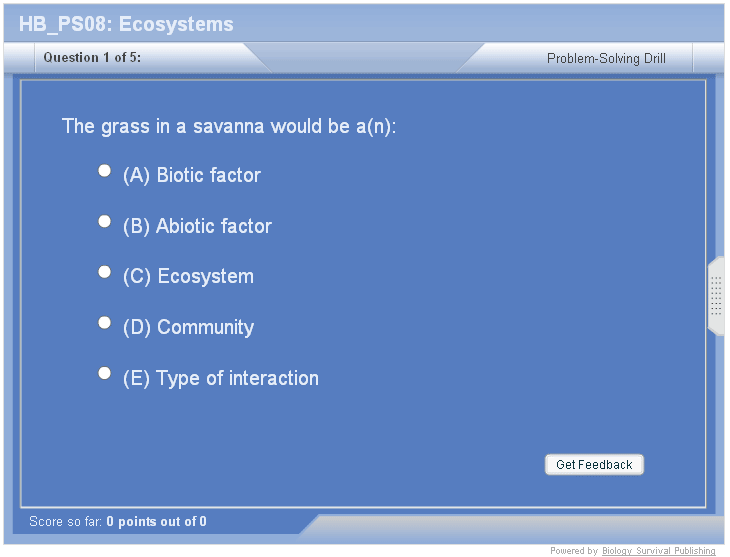
Problem Solving Drill
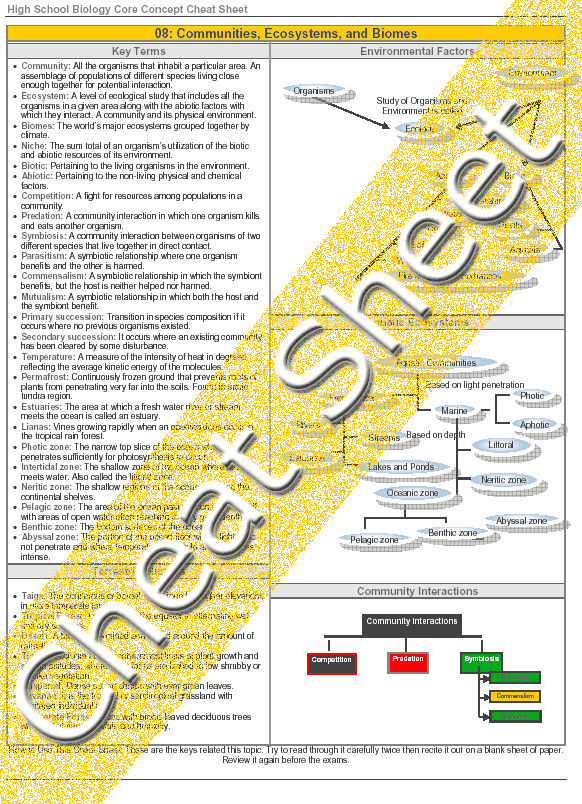
Review Cheat Sheet
"Title" Tutorial Summary :
Community is an assemblage of species living close enough together for potential interaction. Species diversity or richness is the number of species that make up a community which include relative abundance. Some species are quite rare in a community where as other species are plentiful. Coevolution is an interspecific phenomenon which is of great importance in community ecology. Interspecific competition for limited resources determines species diversity in some communities. Closely related species can coexist if there are one or more significant differences in their niches. Succession involves changes in species composition of a community over ecological time. Biogeography is the study of the past and the present distribution of species, deals with species diversity and composition in realms that have boundaries, ultimately associated with the patterns of continental drift. Ecosystem is the level of ecological study that includes all the organisms in a given area along with the abiotic factors with which they interact. The environment of an organism can be divided into two: Abiotic and biotic environment. Biosphere is thin, life supporting skin consisting of seas, lakes, stream, land and atmosphere. Biosphere is a mosaic of habitats differing in abiotic factors such as temperature, rainfall and light. These affect the distribution of biotic factors such as the type of vegetation. Environments change in time as well as space. Individual organisms can respond to changing environments by mechanisms that are behavioral, physiological or morphological. The world’s major communities like deserts, tropical rain forests, grasslands and the like are known as Biomes. The aquatic communities can be divided as fresh water and marine. Rivers and streams are bodies of water continuously moving in one direction.
Tutorial Features:
General concept maps of community ecology
Concept maps of community interactions and ecosystem interactions
Colorful flow chart of chemical cycling
Colorful flowchart of human intrusions in ecosystem dynamics